
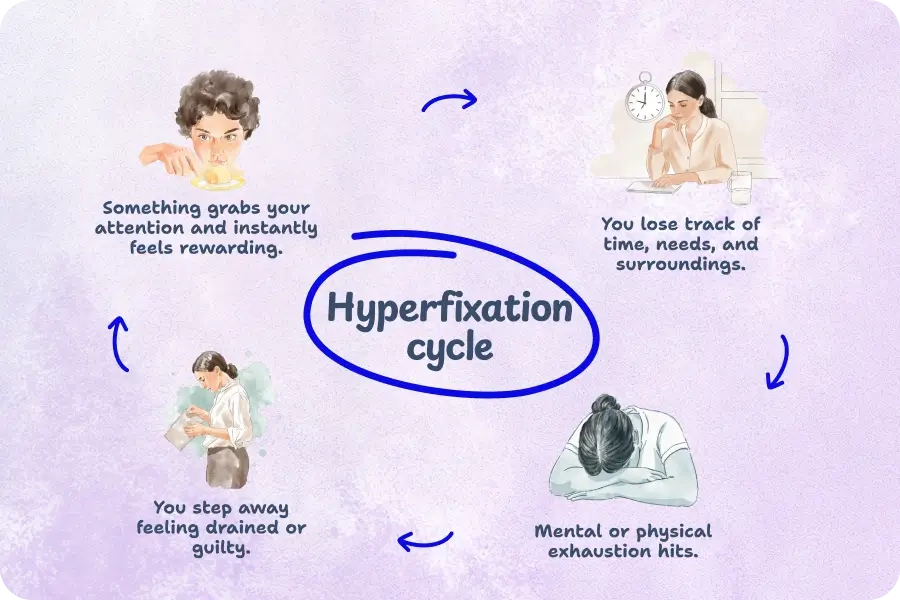
Have you ever started researching one thing at 8 p.m. and looked up to realize it is suddenly 1 a.m.?
Maybe it is a new hobby.
A project.
A video game.
A historical topic.
A person.
A problem you are determined to solve.
Sometimes intense focus feels incredible. You are interested. Motivated. Learning quickly. And completely absorbed.
Other times, you realize you have not eaten, ignored three messages, stayed up far too late, or spent five hours on something you meant to do for twenty minutes.
People often call this hyperfixation.
The important question is not simply whether you can focus intensely. It is:
Can you still choose where your attention goes when you need to?
What Is Hyperfixation?
Hyperfixation is an informal term people use to describe intense, absorbing attention toward a particular interest, activity, person, problem, or goal.
Someone may lose track of time. Switching to another task may feel unusually difficult. The focus may repeatedly pull their attention back even when they intended to stop.
Hyperfixation itself is not a psychiatric diagnosis, and there is no single clinical definition that everyone uses.
Related research often uses the word hyperfocus, particularly in discussions of ADHD. Researchers describe it as becoming deeply absorbed in an activity to the point that other information or responsibilities may temporarily fade into the background. The research is growing, but the concept is still not as clearly defined as established diagnostic symptoms.
That distinction matters.
Having an intense interest does not automatically mean you have ADHD, autism, bipolar disorder, or any other psychiatric condition. Context matters.
What Can Hyperfixation Look Like?
The same intense focus can be useful in one situation and disruptive in another. You might notice:
- Losing several hours to one activity without realizing it
- Having difficulty stopping even when you planned to
- Becoming unusually frustrated when interrupted
- Delaying meals, sleep, hygiene, homework, or other responsibilities
- Thinking about the interest when you are supposed to be doing something else
- Talking about it much more than usual
- Spending more money or time on it than you intended
- Returning to the activity because it feels stimulating, comforting, predictable, or rewarding
- Finding other tasks unusually boring by comparison
None of those automatically means something is wrong.
If you spend Saturday completely absorbed in building something, reading a book, working on music, or learning about a subject you love, and the rest of your life is fine, that may simply be deep engagement.
The clinical question is usually about flexibility and impairment.
Can you stop?
Can you sleep?
Can you eat?
Can you meet responsibilities?
Can you redirect your attention when something else genuinely matters?
Hyperfixation and ADHD
People with ADHD often describe attention as inconsistent rather than simply “too little.”
Something boring may feel almost impossible to begin. Something interesting can hold attention for hours.
Research suggests that adults with higher ADHD symptoms report more episodes of prolonged, highly focused attention, although hyperfocus is not itself part of the formal diagnostic criteria for ADHD.
That is an important distinction. You cannot diagnose ADHD because someone says:
“I hyperfixate.”
ADHD is a neurodevelopmental disorder. Diagnosis involves a persistent pattern of symptoms, with several present before age 12, occurring across settings, causing impairment, and not better explained by another condition.
Hyperfocus can be one piece of someone’s experience. It is not the diagnosis.
Clinically, I would want to know:
- Has shifting attention always been difficult?
- Do you also struggle to initiate tasks that are less interesting?
- Do deadlines disappear until they become emergencies?
- Do you lose track of time?
- Does intense focus coexist with distractibility in other situations?
Again, the pattern tells us more than one behavior.
Autism and Hyperfixation
The relationship with autism is slightly different.
Formal autism criteria include “highly restricted, fixated interests that are abnormal in intensity or focus” as one of four possible restricted or repetitive behaviors, at least two of which must be present. Autism also requires persistent differences in social communication and interaction, beginning in early development.
So if someone asks:
“Is hyperfixation a symptom of autism?”
I would say: intense or highly focused interests can absolutely be part of autism. But one intense interest does not diagnose autism.
For many autistic people, focused interests can be deeply positive. They may provide:
Joy.
Predictability.
Expertise.
Identity.
Comfort.
A sense of mastery.
The goal is not automatically to reduce the interest. The question is whether the person can still care for themselves, meet necessary responsibilities, and maintain enough flexibility to function.
What About “Bipolar Hyperfixation”?
This phrase appears online quite a bit, but I would use it carefully.
Hyperfixation is not a diagnostic symptom of bipolar disorder. During mania or hypomania, however, people can experience increased energy and increased goal-directed activity.
Someone might suddenly begin several projects.
Work through the night.
Become intensely focused on a business idea.
Start writing a book.
Redesign the house.
Exercise for hours.
Or become unusually invested in a plan they feel completely certain will succeed.
That can look like hyperfixation from the outside. The important clue is what else is happening.
Mania and hypomania involve a broader episode that can include elevated or unusually irritable mood, increased activity, racing thoughts, decreased need for sleep, increased talkativeness, inflated confidence, impulsivity, or risky behavior. National Institute of Mental Health
So I would ask:
Is this person deeply interested in something?
Or:
Has their entire pattern of mood, sleep, energy, judgment, and behavior changed?
Those are different questions.
If intense focus comes with several days of sharply reduced sleep, risky decisions, or feeling unusually powerful or invincible, seek a prompt evaluation rather than waiting to see if it passes.
When Does Hyperfixation Become a Problem?
I would not measure it by intensity alone. I would look at what it costs. Ask yourself:
- Time: Am I choosing how much time I spend on this, or does it repeatedly expand beyond what I intended?
- Body: Am I eating, sleeping, moving, and taking care of myself?
- Responsibilities: Is important work, school, parenting, or household life repeatedly being pushed aside?
- Relationships: Are people regularly telling me they cannot get my attention?
- Money: Am I spending more than I intended because of this interest?
- Mood: Do I feel energized and satisfied afterward, or depleted and distressed?
- Control: Can I pause when I genuinely need to?
The goal is not necessarily to give up something you love. It may simply be to build enough structure around the interest that it stays enjoyable instead of consuming everything around it.
Hyperfixation on a Person
This can feel especially intense.
Maybe you keep checking whether they texted.
Replay conversations.
Look at their social media.
Imagine future interactions.
Analyze subtle changes in tone.
Or find that your mood rises and falls depending on how that person responds.
People often call that hyperfixation on a person. Again, the term describes the experience. It does not tell us what is causing it.
Attraction can do this. So can loneliness. Grief. Relationship uncertainty. Fear of abandonment. Anxiety. OCD-related intrusive thinking or reassurance-seeking. Trauma-related patterns. Or simply the intensity of a new relationship.
What matters is whether the focus has begun overriding your boundaries or functioning.
- Are you repeatedly checking?
- Ignoring other relationships?
- Losing sleep?
- Monitoring someone in ways that cross their boundaries?
- Making your sense of worth depend on whether they respond?
At that point, the issue is less:
“Why can’t I stop thinking about this person?”
and more:
“What is this focus doing for me, and what is it costing me?”
How to Manage Hyperfixation Without Killing the Interest
I do not think the goal should be to become less interested in things you love. The goal is flexibility.
A few practical strategies can help:
- Set an external timer before you begin rather than after you have already lost three hours.
- Write down where you stopped so your brain does not feel like it has to keep going or lose the idea.
- Schedule food and water instead of relying on hunger to interrupt you.
- Protect sleep.
- Give yourself a short transition period before the next task.
- Decide in advance what “done for now” means.
And when possible, notice what the activity is giving you.
Stimulation?
Comfort?
Predictability?
Escape?
Connection?
Mastery?
Relief from boredom?
That information can be useful. Sometimes what looks like a problem with attention is actually revealing what the brain is seeking.
Supporting Someone Who Hyperfixates
If someone you care about becomes intensely absorbed in something, criticism usually does not help much. Neither does mocking the interest.
Instead of:
“You’re obsessed with this again.”
Try describing what you actually need:
“I know you’re really into this project. I also need us to eat together tonight. Can we decide on a stopping time before you start?”
That is clearer. It separates the person’s interest from the impact the behavior is having.
You can respect someone’s enthusiasm and still ask for boundaries. Both can be true.
When Is It Worth Getting Evaluated?
Intense focus by itself usually does not require psychiatric evaluation. But I would pay closer attention when it appears alongside other changes. For example:
- A longstanding pattern of attention problems, impulsivity, organization difficulties, and trouble switching tasks may raise questions about ADHD.
- Highly restricted interests combined with developmental differences in social communication, sensory processing, routines, and flexibility may raise questions about autism.
- A sudden increase in intense goal-directed activity accompanied by decreased need for sleep, racing thoughts, unusual confidence, impulsivity, or major mood changes may raise concern for mania or hypomania.
- Compulsive checking or intrusive, unwanted thoughts may point toward OCD or anxiety.
- Depression, trauma, sleep deprivation, substance use, and other conditions can also change attention.
That is why I would not diagnose anything from the word hyperfixation alone. I would want the timeline.
What else happens with it?
Has this always been true?
Or is this a noticeable change from baseline?
That is usually where the useful information begins.
How Rituality Wellness Can Help
Rituality Wellness provides psychiatric evaluation and medication management for adolescents ages 12 and older and adults.
Someone may come in saying:
“I think I hyperfixate.”
That gives us a place to start. Then we ask more questions:
- Has this always happened, or is it new?
- What happens with tasks you do not find interesting?
- Have your sleep, energy, or mood changed?
- Are there problems with organization, impulsivity, anxiety, or intrusive thoughts?
- Are substances, medications, or medical factors contributing?
Sometimes intense focus fits into an ADHD picture.
Sometimes autism-related traits deserve further evaluation.
Sometimes the concern is anxiety.
Sometimes the change in focus is happening alongside a mood episode.
And sometimes someone simply has an intense interest that is not a psychiatric problem at all.
The purpose of evaluation is not to turn every personality trait into a diagnosis. It is to understand the larger pattern.
Rituality Wellness offers in-person psychiatric care in Haymarket and telehealth psychiatric care throughout Virginia.
The Bottom Line
Hyperfixation can be productive. Creative. Comforting. Fun. And meaningful.
It can also become disruptive when it repeatedly pushes aside sleep, health, relationships, or responsibilities.
The word itself does not diagnose anything. Look at the larger pattern.
What does the focus give you?
What does it cost you?
Can you redirect your attention when life requires it?
And perhaps most importantly:
Has this always been part of you, or is something noticeably different right now?
That distinction can tell us a lot.
Frequently Asked Questions
Is hyperfixation a symptom of ADHD?
People with ADHD commonly report episodes of hyperfocus, and research suggests prolonged intense focus may occur more frequently in adults with greater ADHD symptoms. However, hyperfixation or hyperfocus is not itself a diagnostic criterion for ADHD. PubMed
Is hyperfixation a symptom of autism?
Highly restricted or fixated interests can be part of autism, but autism involves a much broader developmental pattern. An intense interest alone is not enough for diagnosis. CDC
Does bipolar disorder cause hyperfixation?
“Bipolar hyperfixation” is not a formal clinical symptom. Mania and hypomania can involve markedly increased goal-directed activity, energy, racing thoughts, decreased need for sleep, impulsivity, and other changes that may sometimes look like unusually intense focus. National Institute of Mental Health
Is hyperfixation always unhealthy?
No. Deep interests can support learning, creativity, expertise, enjoyment, and connection. It becomes more concerning when the person repeatedly loses flexibility or the focus interferes with health, sleep, responsibilities, relationships, or safety.
What should I do if hyperfixation is interfering with my life?
Start by looking at its impact rather than trying to eliminate the interest. External time cues, sleep and meal boundaries, stopping rituals, and transition periods may help. If the pattern is persistent or appears alongside significant attention problems, mood changes, anxiety, compulsive behavior, or other symptoms, a professional evaluation may help clarify what is happening.